Hints and Tips

The Neglected Digit

Think about your hands for a moment - which parts of them do you feel are most critical to your recorder playing? My bet is you mostly consider your fingers and left thumb - we naturally see these as doing most of the heavy lifting. But what about the digit which literally does the heavy lifting - your right thumb? We often take this one for granted - after all, it doesn’t have a hole to cover, so it somehow seems less important, doesn’t it? This message from Richard, one of my Score Lines subscribers, got me thinking, and made me realise our most neglected digit deserves a blog post of its own! 

“Much has been written about technique but strangely little is mentioned about the right thumb.  Indeed, I never thought about it other than to recognise that it supports the instrument. I was experiencing some difficulties with bottom F - my hand and fingers are not as nimble/flexible as they were - and I began to think about whether altering the position of my right thumb was an issue. Was it optimally positioned - indeed what do experts advise?  I found nothing!”

A supporting and enabling role

In common with most woodwind instruments, the right thumb’s role in recorder playing is mostly a matter of support - only on the bassoon does it also have to cover a hole or press keys. This digit’s job is a supporting and enabling one - namely holding our instrument up and ensuring our other thumb and fingers can do their tasks easily and efficiently.

There are two main considerations for your right thumb - using it effectively to support the instrument and the way its position affects your overall hand shape. Both of these have an impact on the ease and level of success with which you play. Placing your thumb in the wrong place on the back of the recorder can have a detrimental effect on your playing, and sometimes result in discomfort too. 

Fundamentally, your right thumb is there to support the recorder, thus enabling your fingers to cover the holes and to move freely at all times.

In search of the perfect hand position 

You may well be familiar with this image, taken from Principles of the Recorder, Flute and Oboe by Jacques Hotteterre le Romain. Only the fingers on the top surface of the recorder are fully visible, but analysing their position tells us a lot about where our thumbs should be as well. 

Look at the shape of the fingers and their position, relative to the recorder. They’re gently curved, adopting the shape they naturally take when at rest, and lie more or less at ninety degrees to the recorder. If you have one nearby, grab a recorder (I suggest a descant or treble) and try to emulate this finger position with your own hands. Now look down at your hands and see where your right thumb ends up. 

If you follow this example to the letter, you may find your right thumb doesn’t even reach the back of the recorder - this is partially dependent on the relative lengths of your thumb and fingers, as well as the size of recorder you’re holding. If this is the case, gently move your thumb over until it finds a natural position on the back of the instrument. It’s a good idea to stand in front of a mirror while doing this, as it allows you to easily see the position of your fingers too. Don’t forget to hold the recorder up to your lips so you can really gauge your natural playing position.

What’s the perfect position for your right thumb?

This varies from person to person, depending on their hand size - after all, we’re all built slightly differently. In general though, the best position is somewhere between the 4th and 5th finger holes. I’ll come back to this later, when we consider how to achieve a consistency of thumb placement.

Hand shape can have a big impact

As you hold your recorder up to play, look down at the shape of your hand. How much space is there between your thumb and first finger? Are they close together, or is there some room between them? Ideally you’re after a rounded space beneath your fingers - imagine being able to pop a small satsuma or tangerine in the palm of your right hand! 
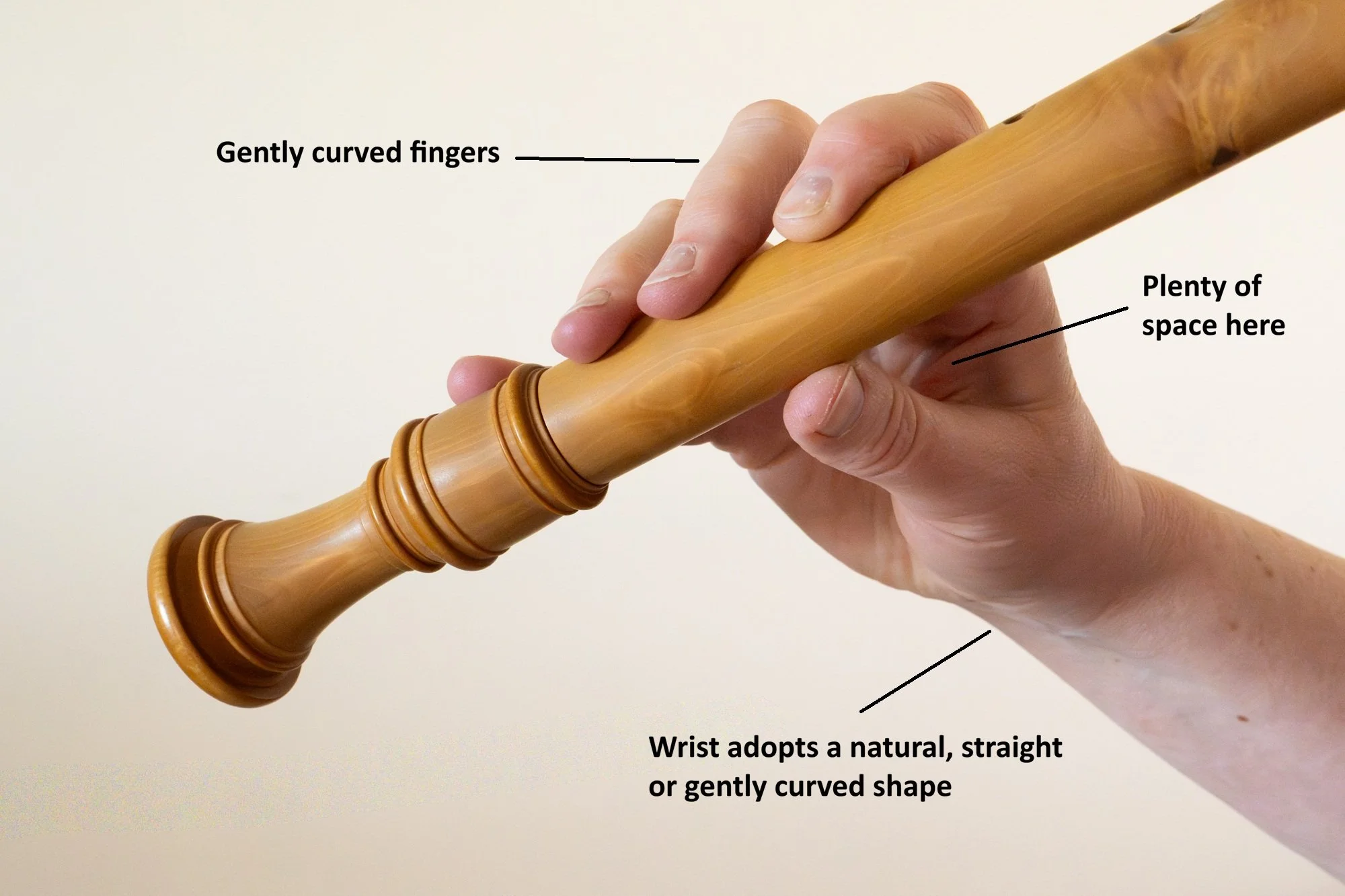
A good hand position

Now look at the position of your right wrist. Try to avoid dropping your wrist towards your body. Doing so reduces the space between thumb and fingers, creating tension across your knuckles. Tension is never a good thing! Aim for a natural, gentle, convex curve in your wrists which is a continuation of the shape of your fingers. If you’re not sure whether you’ve found the right position, try intentionally dropping your wrist and see how it feels. You’ll immediately notice it’s harder to cover the finger holes and your knuckles will feel more tense and restricted. 

When the right wrist drops it negatively impacts the position of the fingers too

How bendy are you?

We all naturally have differing levels of flexibility in our bodies. Having a good range of movement in our joints is generally a positive thing, but for those who are very bendy, or even have hypermobility, it can create difficulties. Hold your right hand in front of you, as in the picture below, as though giving someone a ‘thumbs up’. How far does the tip of your thumb curve back on itself? For most people it will bend a little, but for those who are double jointed or hypermobile it can comfortably stretch almost as far as ninety degrees - this is sometimes known as a ‘hitchhikers' thumb’, as you can see below.
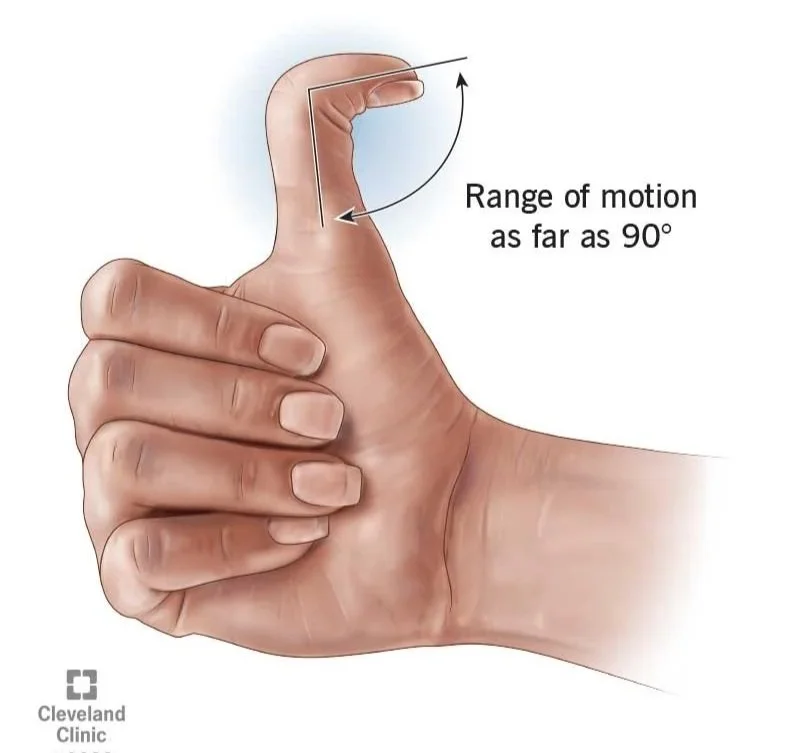
For recorder playing this can result in a less than ideal position for either hand. For the right hand, it can reduce the space between thumb and fingers when holding a recorder, resulting in tension across the knuckles as I’ve described above. If you recognise this description in your own hands, try bending the top joint of your thumb a little to open up this space, rather than just allowing it to flop into its totally relaxed, overextended position. This may help, if you can get used to a change of position, but I have another solution which I’ll talk about below.

Make gravity your friend

Its not uncommon to feel the recorder is in danger of slipping though your hands when playing. If this occurs, players sometimes end up resting one of their fingers between the holes (often the right hand first finger) for extra support and control. This is far from ideal, as those fingers should really be concerned merely with covering the holes!

If this description seems familiar, try lifting your recorder up a touch more, moving it slightly closer towards a horizontal position than a vertical one. Doing so changes the instrument’s centre of balance, allowing gravity to gently push its weight down onto your right thumb. Even a small change here can have a big effect, making it feel that the recorder is less likely to slip from your hands.

Compromise is sometimes necessary

Just as the length of your thumb can affect how close you get to the ‘perfect’ hand position, the size of recorder you’re playing also has an impact.

For most people, smaller recorders, such as descant and treble, can be played with little difficulty, but when it comes to the larger instruments compromises sometimes need to be made in order to cover the finger holes. It’s not unusual to have to drop the right wrist a little in order to play the tenor recorder, simply because the distance between the finger holes is greater. However, when we reach the bass, this stretch required is often diminished again because of the addition of keys to cover certain holes.

To play my straight tenor recorder I have to drop my right wrist a little, but I have fairly long fingers so I can still cover the fingerholes without difficulty.

The Knick - a practical trade off

In recent decades Knick instruments have become much more commonplace - especially tenor and bass recorders. The bend in the head joint brings the body of the recorder closer to your own body, reducing the strain on the arms and making it easier to reach the finger holes. In general this is a positive thing, but there’s a trade off as it also change the instrument’s centre of gravity. I’ll talk about instrument supports in a moment - for knick instruments they’re particularly critical.

Having the knick shifts this middle joint into a more vertical position. This can make it feel as though the instrument is going to slide down through your hands - after all, the very nature of gravity pulls things downwards. I would argue that all knick instruments (be it a tenor or bass) really need a thumb rest. Many have one installed when purchased, but if yours doesn’t I would have one fitted as soon as possible.

New innovations 

In recent years Kunath recorders, who make the square Paetzold instruments, have been innovating, allowing those with small hands to try sizes of recorder which might otherwise have been impossible to play. At the more expensive end of the scale there’s the Paetzold knick tenor, which has keys to cover all the finger holes. The end of the recorder rests on the seat between one’s legs, taking away all worries about supporting the instrument.

More recently, they’ve come up with a more modestly priced solution - the Sigo tenor. This has a folded internal bore (following the principle of the renaissance rackett), resulting in a tenor where the stretch between holes for the fingers is somewhere between that of a descant and treble. I know many players for whom this has been a real game changer, allowing them to play the tenor comfortably for the first time. A bass Sigo is also in the works, so it’ll be interesting to see if that is similarly impactful. 

With both the Sigo and the Paetzold knick tenor, the right hand thumb position becomes much less critical as your seat provides all the support, allowing you to focus entirely on the fingers. Their tone and response may not be to everyone’s taste, but it’s been wonderful to see so many people exploring the mellow tones of the tenor without the discomfort faced by those with small hands.

Does your thumb need some help?

On larger recorders it’s not unusual for a thumb rest to be added to help you support the instrument, but don’t dismiss the idea of some assistance on smaller recorders if you need it. If a thumb support of some type makes it more comfortable and easier to play, there’s absolutely no reason why you shouldn’t use one.

Let’s look at the possibilities for recorder supports…

Traditional thumb rests

This is perhaps the most obvious way to help support your recorder, and they come in many different forms. Some instruments (basses for instance) come with a thumb rest pre-installed, and these sometimes include a screw mechanism to allow for adjustment. As we’ve already noted, hands come in many different sizes and in varying proportions, so one size doesn’t necessarily fit all. 
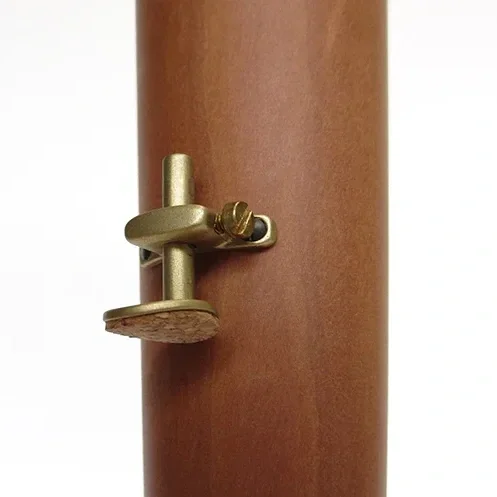
For smaller recorders, thumb rests come in many different styles and materials. If you’ve never used a thumb rest and want to see if it’s the answer for you, the simplest solution can be a piece of BluTack or Plasticine before committing yourself to something more permanent. You only need a small piece, and it can be shaped and re-shaped to suit your needs. I would start by placing it on the back of the recorder, somewhere between the holes 4 and 5. If this allows you to comfortably cover the holes that’s great. If not, try moving it up or down a little until you find the perfect spot. 

If this solution works, you might wish to go for something a little more aesthetically pleasing and/or permanent. A great, cost effective solution is a clip on plastic thumb rest, like those for descant, treble and tenor, made by recorder manufacturer Aulos. They only cost a couple of pounds and can be easily slid on and off the recorder. They blend in perfectly with plastic recorders, but take care when attaching them to wooden instruments to avoid scratching the surface of the wood. 
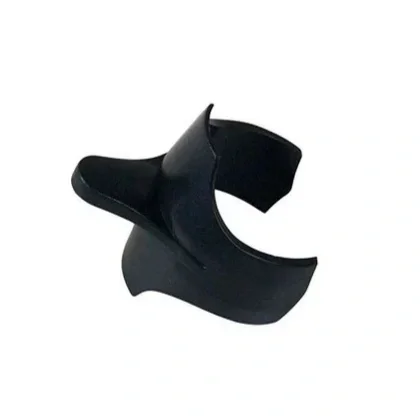
Photo from Early Music Shop

I’ve also seen recorder players who fashion a personalised thumb rest from modelling clay, such as Sugru. This solution gives you the chance to mould it to the perfect shape before it cures permanently. Sugru will attach to wood if you put it in place before the material has cured, but be aware that it may leave a mark if you later remove it. But there’s nothing to stop you moulding a thumb rest from this material and then attach it with double sided adhesive tape or a suitable type of glue once it’s set into its final shape. Sugru comes in many different colours, so this solution may allow you to find a shade which closely matches the wood of your recorder.

If you want a more permanent solution, you can buy wooden or metal thumb rests which can be glued or even screwed to the instrument. If you consider attaching one permanently, I would recommend consulting an experienced woodwind repairer for advice on the best type of attachment to use, lest you do irreparable damage to your favourite instrument! 

Where to place your thumb rest

The most efficient and comfortable position for a thumb rest will vary, depending on the relative length of your thumb and fingers. For most people though, a good starting point is around halfway between the fourth and fifth finger holes. I would begin by experimenting with a temporary rest, shifting it up and down a small amount until you find the right spot for you. Bear in mind that the perfect position may vary between the different sizes of recorder.

Each time you move your temporary thumb rest, really take some time to explore how each change of position feels. Does moving it up or down a little help you cover the finger holes more easily? Moving it too low down can create unnecessary tension in the bottom joint of your thumb, as well as restricting the movement of your fingers, so take your time and really analyse what feels most comfortable.

Thumb rests for the terminally indecisive

Most people find a single position for their thumb rest which allows them to support the instrument and cover the finger holes effectively. However, it can take a little while to find the perfect spot. For those who can’t quite make up their mind I have a few practical solutions…

I’ve already mentioned the possibilities if Blutak/plasticene above, but another option is a short length of ribbon or cord. Many recorders have decorative mouldings on the foot joint and you can anchor the ribbon around these. You then create a loop of ribbon, into which you tuck your right thumb. It can be a little fiddly to install, but once you’ve got the length right it’s a lightweight and flexible way of supporting your instrument without having to glue anything in place.

A friend of mine recently shared a different solution she’s alighted upon. Attaching a small piece of fine grade sandpaper to the back of your recorder using double-sided adhesive tape, with the rough side facing your thumb, it creates a small amount of friction to help hold the instrument against the skin. This solution doesn’t provide any active support, but can offer a little more reassurance than the natural shiny surface of a recorder. When the sandpaper loses its roughness it can easily be replaced with a fresh piece. Incidentally, the curved corners to the sandpaper in the image below make it less prone to peeling away. As you can see here, my friend Rose combines this with a home made thumb rest made of Sugru, creating a positive sense of security when playing.

Is it okay to use a thumb rest on smaller recorders?

Absolutely, it is!

I’ve met players over the years who don’t use a thumb rest as a matter of pride - somehow they feel using one would be tantamount to admitting they’re less of a player. I disagree with this and take a pragmatic approach. If a thumb rest makes playing more comfortable and allows you to cover the finger holes with ease, you are within your rights to do so on any size of recorder.

When I taught the recorder to young children I would habitually provide them with a clip on thumb rest (like the Aulos one pictured above), even on a descant recorder, and especially if they had small hands. Doing so meant they consistently put their right thumb in the correct position from the start and allowed them to have a good sense of stability and control as they played. With a thumb rest in place from day one, it also meant they were less likely to get into the bad habit of resting their fingers on the instrument between the finger holes. As we all know from painful experience, it’s always better to create good habits from the start than to have to unlearn bad habits later. As my pupils grew they sometimes removed the thumb rest later, but by that stage they had good habits in place and were able to hold the recorder with confidence.

Yes, I realise that most of my Score Lines readers won’t be children, but there’s absolutely no reason why you shouldn’t use a thumb rest if it helps you at any age!

Other methods of support

Larger recorders, such a tenors and basses may require more support than just a thumb rest, to compensate for their additional weight. Most bass recorders come with a sling (which can be worn around the neck or across the body), but there’s another possible solution - a spike. This attaches to the bottom of the instrument, transferring all the weight into the ground. Some bass recorders are now supplied from the maker with a screw-in spike (the Kung Superio bass comes to mind), but detachable ones (attached with a ring of Velcro) are available for any variety of bass recorder. I have an aluminium one, made by Anthony Barrett (pictured below), but wooden ones are also available.
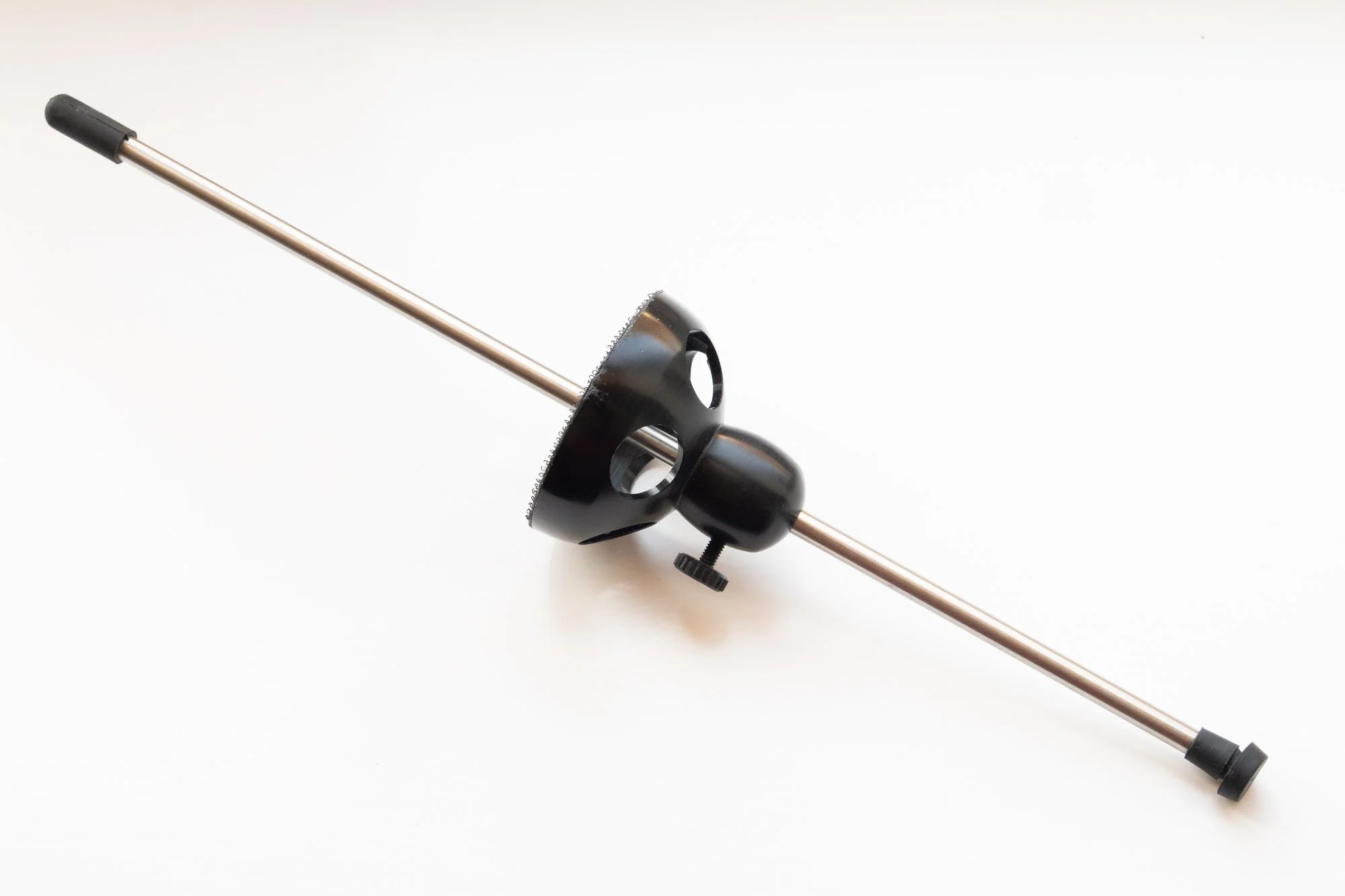
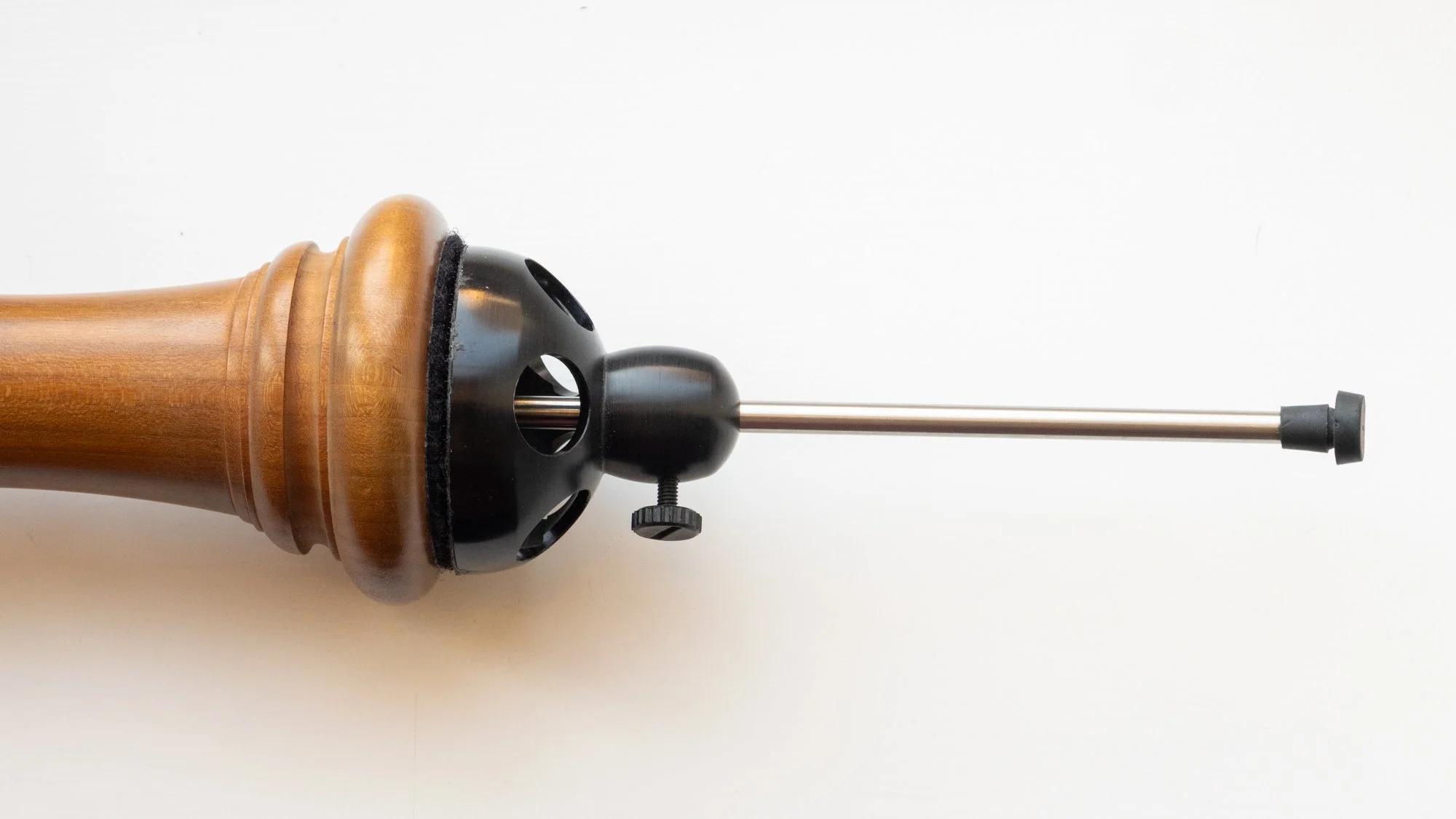
The buttress finger

I’ve already mentioned the dangers of resting the right hand first finger against the recorder for additional support. This particular finger is needed for many notes and doing this can really slow down your playing. However, the concept of using a ‘buttress finger’ is a technique many players use. Compared to the other right hand fingers, the little finger spends much more time in the air and is only occasionally required to cover a finger hole. This means it can be used as an additional point of support. By resting it on the decorative beading at the top of the footjoint, it works in tandem with the right thumb to create a greater sense of balance and security.

I sometimes do this myself, although there are certain pieces of music (I first discovered this while learning the Vivaldi Concerto in C minor) where it’s less convenient as I need the little finger more often than usual to shade the lowest hole to tune certain notes. This may not be a problem in the repertoire you play though, so I would definitely give it a try and see if it helps you.

Challenges for the ‘mature’ recorder player

As I’ve already mentioned, achieving the ideal hand position can be tricky for those with overly bendy hands. But similar issues can often afflict all of us as we age. Getting older brings many benefits - greater knowledge, experience, confidence - but sadly for many it can also bring arthritis and decreased flexibility. When this strikes the hands it can result in deformed joints, sometimes making it harder to cover the finger holes cleanly. 

If this problem makes it difficult to cover the lowest holes, one solution is to buy a recorder with keys, or to have additional keys installed on existing instruments. But if arthritis affects the bottom joint of your right thumb this doesn’t necessarily solve the problem entirely. Many years ago one of my adult pupils encountered exactly this problem and her solution was to create a built up thumb rest from layers of cork. Moving the right thumb away from the recorder opened up the space within the palm of the hand, allowing her to reach the fingerholes more comfortably. Ultimately she commissioned someone to make a wooden thumb rest of the right height for each of her recorders, which served the same purpose and looked very elegant. 

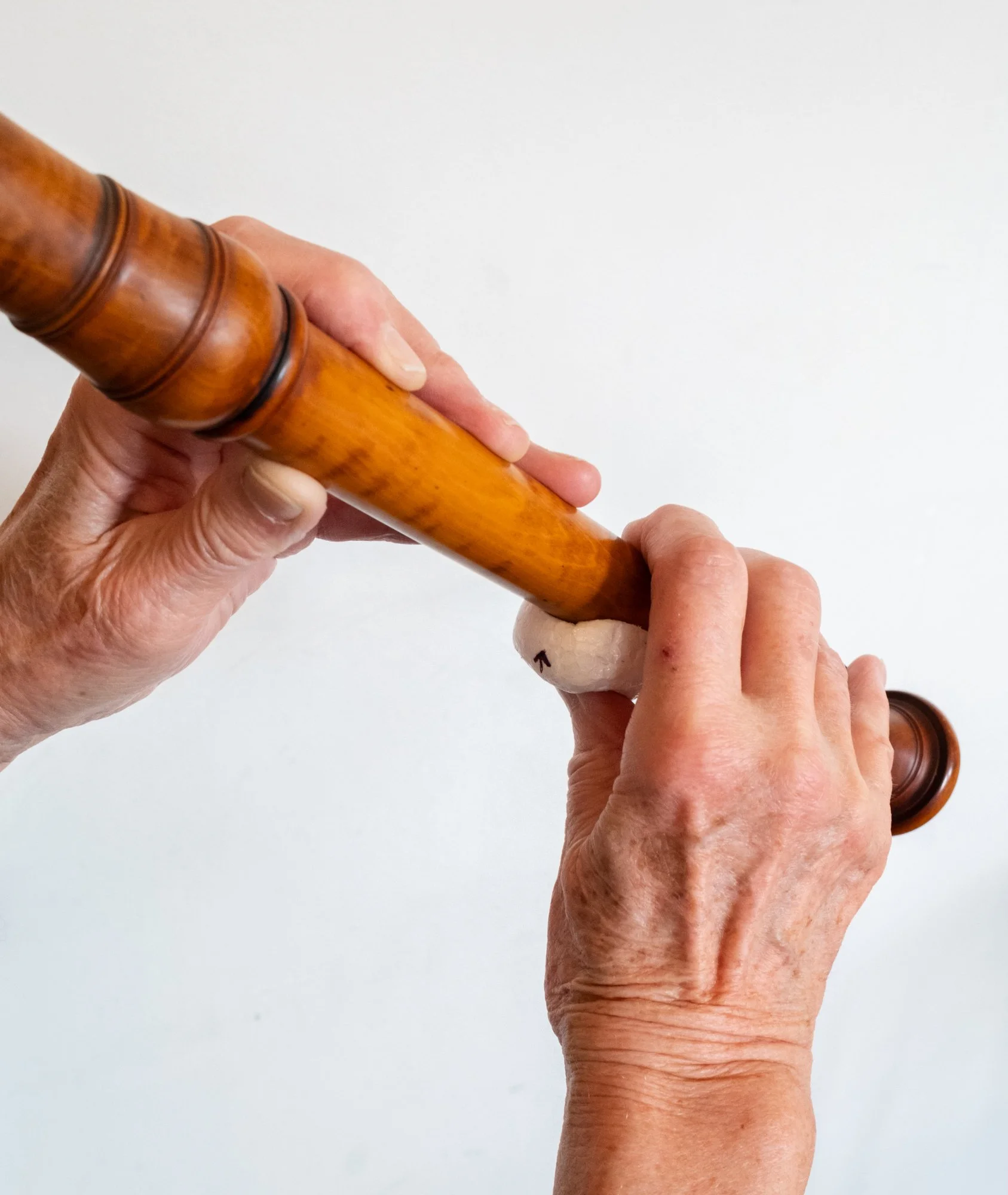
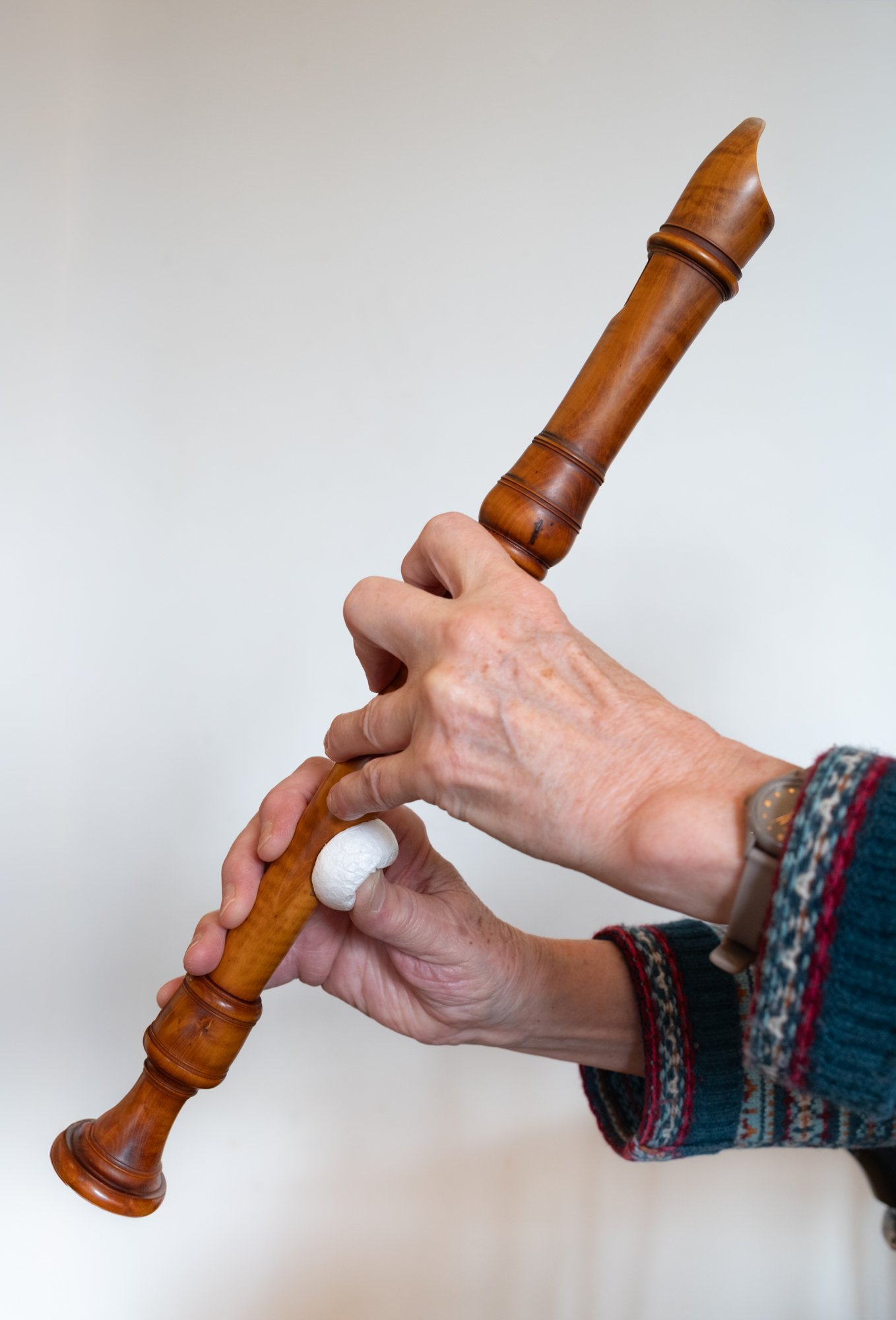
More recently, another friend of mine has faced the same problem and has come up with an equally ingenious solution. A simple polystyrene ball, purchased from a craft shop, can be easily carved out to fit onto the back of the recorder, with a small scoop excavated from the opposite side for the thumb to rest beneath. Once shaped to the right proportions it can be attached with double sided tape or even an elastic band. 

If arthritis means you’re struggling to reach the lowest finger holes, I suggest you explore this solution. These balls can be bought inexpensively, in many different sizes, and with a little trial and error you’ll find the perfect size to give your right thumb the appropriate degree of ‘lift’. For my friend, this has enabled her to keep playing the recorder as the arthritis in her thumb has progressed and she’s now created appropriately sized rests for all her recorders.

Many thanks to Jan for allowing me to take and share some photos of her thumb rests (and hands) - I’m sure these explain the concept better than my words could ever do! If this is a problem you’re facing I hope it may inspire you to explore this option and hopefully keep playing for many more years.
How’s your right thumb doing?

Have my words made you look at this neglected digit in a new light? Have you spotted something in your own hand position which would benefit from some care and attention? None of this is rocket science, but sometimes a small adjustment can make a real difference to our playing. I’d love to hear if this helped you and perhaps triggered you to make some changes to your technique. A big thank you to Richard, my Score Lines subscriber, whose email inspired this blog post - your words made me think in a new light about my right thumb! As ever, please do leave a comment below if you have questions or feedback - who knows your comment could start my train of thought towards the next Score Lines blog!
The Practice Diaries

I’ve written about practising before, but always in a theoretical, didactic way - introducing you to the principles of practising. While conducting a recent orchestra rehearsal we encountered a passage containing some fast moving notes for most of the players. Naturally I encouraged them to practise these bars before our next rehearsal, but I also talked more specifically about how to practise them.

This topic has been uppermost in my mind of late as I’m working towards a concert myself. In one of the pieces we’re going to perform I have a couple of passages which stretch my technique and need some serious tidying before the concert. I’ve been working on this section each day and it occurred to me that you might find it interesting and useful to actually see and hear first hand what I do when I practise. So here we have The Practice Diaries - what may become the first in an occasional series. Using short video clips (most are 2-3 minutes long) I’ll take you along on the journey with me, explaining the process and hopefully you’ll see some progress along the way. The first few videos all come from one practice session, bringing you up to speed on the music I’m learning, plus some insights into what I’ve done so far.

Let’s jump into this warts and all exploration of my practice techniques. It won’t necessarily be pretty, but hopefully seeing my personal failings and successes may inspire you to make some of your own!

What are we practising?

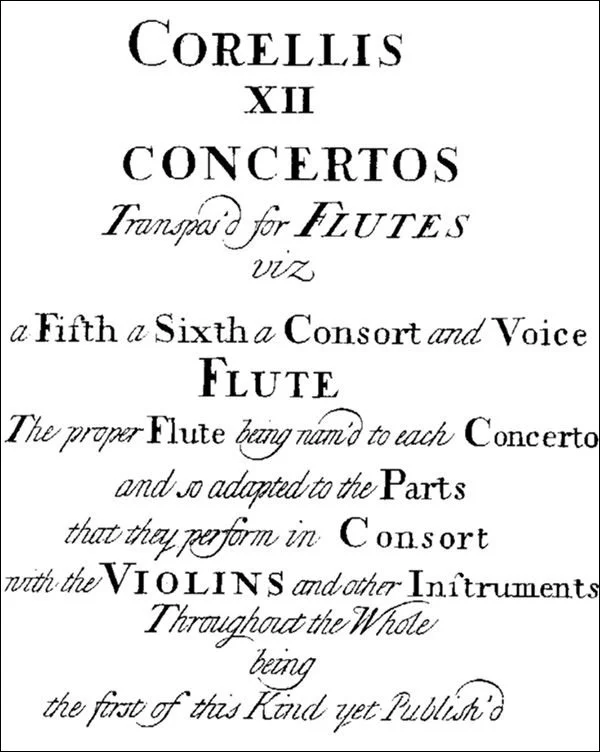
The piece I’m focusing on here is Corelli’s Concerto Grosso Op.6 No.8 - often known as his Christmas Concerto. During the 18th century an alternative edition of it, with the solo violin parts transferred onto recorders, was published by John Walsh, with the advice that it could also be played as a trio sonata. That’s exactly what we’ll be doing - using two recorders, cello and harpsichord.

Day 1 - let’s get started…

Although this is Day 1, I’ve been practising the Corelli for a couple of weeks already, so let me explain my journey to this point. But before that, here’s one passage which particularly needs my attention - the semiquavers from bar 70 to 80. The image below is a snap of my own copy, complete with my pencil markings, which are intended to help me play it better.

Corelli Christmas Concerto, 4th movement - Adagio-Allegro.

Let’s begin with a brief introduction to the music and this new project…

Although I’ve played this piece before, I still need to asses how much work there is to be done, considering one or two small adjustments to make it feel more recorder-friendly…

The next step is to identify where I’m particularly prone to glitches and mistakes. I mark these in my music as a warning, reminding me that I need to concentrate even more in these spots.

Next I explain the way we learn when we practise and what goes on inside our bodies to make sure the work we’ve done stays done!

I wrote another blog post about this topic last year and if you haven’t already read it, I strongly suggest you do. When I learnt all about the magic of myelin it was a real game changer for me - you can read all about it in my blog post here. In these early stages, practising slowly is the best thing you can do, ensuring you’re not learning mistakes into the music.

Do you love your metronome? I love mine!

Used in the right way it can be a fantastic tool, especially when you want to gradually increase the speed of a piece of music. Here I talk about the way I use a metronome when I’m practising.

If you want more metronome top tips why not take a look at my blog post all about this brilliant and much maligned tool?

But how does a metronome help you increase the speed of the music? I have a cunning plan which, with a little patience and persistence, is utterly foolproof - watch it in action here…

Having explained my strategies for the early days of practising a difficult passage, let’s see if the work I did yesterday has stuck, and find out which bits still need some polishing…

If you feel you’re making good progress, a clever way to test this is by making the music even harder. Let’s take a look at my own strategies and how well they can work…

It’s very easy to get caught up in thinking about your fingers, forgetting about all the other things you need to consider at the same time! Here I talk you through some of these:

Have you ever tried practising the music backwards? I did just that and discovered that it can be another really useful strategy!

How long should we practise for and how often? Here I ponder the ins and outs of practice routines. You might be surprised how much you can achieve in a modest amount of time if you practise in the right way.

In today’s practice session I realised that hidden dangers occur when familiar patterns change…

My final snippet from today’s practice session - let’s see how much progress I’ve made…

Now it’s time to go and do some different work - I’ll return in a few days with some more updates and glimpses behind the scenes, warts and all!

Day 2 - more thoughts on alternative fingerings, relaxation and when to feel you’ve really fixed a problem

After a good night’s sleep I’m back on the case, now turning my attention to a different section of the music, shown in the image below. Once again you can see I’ve marked the groups of notes which need my attention.

Corelli Christmas Concerto, 6th movement - Allegro

I started this project to help you with your practice, but looking back at the previous day’s clips I realised they had their uses for me too!

At what point can you say you’ve really mastered a passage? I consider this today and find out if I can put my own advice into practice…

My final thought for today - using smooth or detached articulation.

Day 7 - getting to grips with slurs and changing gear

Five days have passed since I last spoke to you, but I’ve been practising every day, making incremental improvements. Each day new ideas occur to me, so let me explain some of my latest discoveries with you…

We’ll start off by thinking about how I can control the movement of my fingers more effectively while I’m playing slurs.

There comes a point, when practising with a metronome, that a gear change is required. As I’ve gradually increased my speed that moment has arrived - here I talk you through my thought processes on this.

Here we have a fresh scan of my music. Over the days I’ve gradually added a few more markings, to help remind me what I need to think about and where. These include updates on where my metronome practice has got to, and notes about the specific fingers I need to work more efficiently as I play.

My final thought for the day is when you should stop practising. Concentration is a finite resource - knowing when your allocation for the day has run out will help you practise more efficiently and effectively!

Day 12 - playing with other people and trying to overachieve

After a weekend off and a rehearsal with my colleagues I have a much clearer perspective on how successful my practice has been so far…

Playing the music at the right speed is one thing, but it pays to build in a margin for error. Here I look at my aims for the remaining few days before our concert.

Finally, I consider the possibility of making mistakes during the concert - after all, no one is perfect!

The final countdown…

As I publish this post, we have six days left until our concert, but will I be ready for whatever a live performance can throw at me?

I’ve practised in a thoughtful way, taking small steps to work on my weak areas. At no point have I spent more than an hour a day on my practice, but instead I’ve focused the bulk of my attention on the passages that need the most work.

What about the rest of the concert programme?

Alongside the Christmas Concerto I’ve spent shorter periods tidying up the other pieces. It’s rare to perform an entirely new programme in any concert, so many of the other works are ones I’ve played before and know well. I keep these ticking along in parallel with the Corelli, but the good quality practice I’ve done one them in preparation for previous concerts means they don’t need the same quantity of work.

Have you enjoyed this glimpse behind the scenes?

Practice can seem like a dark art. People talk about it a lot, but how often do you get to see and hear exactly how a professional practises?

I hope this look behind the scenes has given you some inspiration for your own practice sessions. Please bear in mind I’m coming to this work as someone who’s spent many years studying; developing my technique and musicianship. Some of the music I find easy may seem like an impossibility for you at the moment, especially if you’re still near the beginning of your recorder journey - please don’t let that put you off. All of the techniques I’ve talked about and demonstrated in these video clips can be modified and used in your own practice sessions. Your tempi may be slower, and your pace of improvement may be more modest, but I absolutely believe that anyone can become a better musician and technician if they practise in the right way.

If you’ve found this video diary helpful, please do let me know by leaving a comment below. Is this something you’d like to see more of? If so, are there specific topics or techniques you’d like help with? I have lots of ideas, but they’ll be so much more meaningful if I know what you’d like help with.

Advice from beyond the recorder world

Every so often friends send me pieces of writing they think I might appreciate. Two of these struck a particular chord, and I thought I’d share sections of them with you. Chick Corea and Richard Strauss come from very different musical genres, neither of them with any connection to the recorder, but I think their words still have something to teach us.

Cheap but good advice for playing music in a group

This is the title of a list shared with me by Steve Marshall, himself a composer who most recorder players will have encountered at some point. Steve has spent a lot of his life playing jazz, so naturally he would have a greater knowledge of the work of Chick Corea (1941-2021), an American jazz musician, composer and band leader, than I do. Of course, not all of Corea’s advice is applicable to playing the recorder, but these items which particularly jumped out at me as being pertinent to our own music making…

  • Play only what you hear.

  • If you don’t hear anything, don’t play anything.

  • Don’t let your fingers and limbs just wander – place them intentionally.

  • Leave space – create space – intentionally create places where you don’t play.

  • Make your sound blend. Listen to your sound and adjust it to the rest of the band and the room.

  • Don’t make any of your music mechanically or just through patterns of habit. Create each sound, phrase, and piece with choice – deliberately.

  • Guide your choice of what to play by what you like – not by what someone else will think.

  • Use contrast and balance the elements: high/low, fast/slow, loud/soft, tense/relaxed, dense/sparse.

  • Play to make the other musicians sound good. Play things that will make the overall music sound good.

  • Play with a relaxed body. Always release whatever tension you create.

  • Create space – begin, develop, and in for phrases with intention.

  • Never beat or pound your instrument – play it easily and gracefully.

Advice from the conductor’s rostrum

Richard Strauss, painted by Max Liebermann, CC0, via Wikimedia Commons

Richard Strauss (1864-1949), whose life overlapped with Chick Corea by just eight years, occupies a very different musical style, but like Corea, he was a prolific composer and a musician whose words are still pertinent to the rest of us. This collection of musical advice was sent to me by another composer of recorder music, Michael Graham. Like myself, Michael spends a lot of his time conducting ensembles and orchestras, and he thought I might appreciate Strauss’s Ten Golden Rules for Young Conductors. While some of these comments may not be applicable to you as a recorder player, the humour is undeniable, and yet his words have a lot to teach about making music sympathetically with others.

 
  • Remember that you are making music not to amuse yourself, but to delight your audience.

  • You should not perspire when conducting. Only the audience should get warm.

  • Conduct Salome and Elektra (two of Strauss’s most challenging operas) as if they were by Mendelssohn: Fairy music.

  • Never look encouragingly at the brass, except with a brief glance to give an important cue.

  • But never let the horns and woodwinds out of your sight. If you can hear them at all, they are still too strong.

  • If you think that the brass is now blowing hard enough, tone it down another shade or two.

  • It is not enough that you yourself should hear every word the soloist sings. You should know by heart anyway. The audience must be able to follow without effort. If they do not understand the words, they will go to sleep.

  • Always accompany the singer in such a way that he can sing without effort.

  • When you think you have reached the limits of prestissimo, double the pace.

  • If you follow these rules carefully, you will, with your fine gifts and your great accomplishments, always be the darling of your listeners.

If you’d like to see Strauss’s conducting for yourself, this film from his 1944 recording of his own tone poem, Till Eulenspiegel, makes fascinating viewing. He’s a model of minimalism and economy of movement - something I know I could sometimes learn from!

With that I’ll leave you to ponder the advice of these masters, I’m off to figure out which section of a recorder orchestra is the equivalent of the brass, with whom Strauss evidently had something of a love/hate relationship! Many thanks to Steve and Michael for sharing these gems with me - if you’ve come across useful musical advice from an unlikely place which might help others why not leave a comment below so we can all enjoy it?

The art of listening

Photo by Rupam Dutta

I’ve written before about the act of listening, while playing music and as an audience member. My blog post from 2021, The Importance of Awareness, focused mostly on paying greater attention to the musical world around you as a participant, from the physicality of your technique, to the creative use of expression in your playing and awareness of those with whom you are playing in an ensemble.

Today we’re going to widen our listening to the work of other composers and performers.

For most people listening is an activity we do for pleasure - perhaps we allow the music to wash over us as a way of relaxing, or maybe we’re inspired by the virtuosity of professional performers. As a performer and teacher, I’m very accustomed to listening to music in a critical way. That might be in a pupil’s lesson, picking up on both the positive and negative elements of their playing and musicianship. Or it could be while I’m listening to a recording or live performance, noting the way the musicians interpret the music, or how the composer has chosen to structure it. During my student years we spent a lot of time listening in an intentional and active way, because this is a great way to learn how music is composed.

Passive listening can be a wonderful thing, but opening your ears in a more active way can teach you a huge amount - it’s this we’ll be looking at today.

“Music is organised sound”. Edgar Varèse, composer

All the music we play and listen to has a high level of organisation - it’s this that helps us understand it as a listener, whether we do so instinctively or through an understanding of the composer’s methods. But have you given much thought to exactly how a composer organises the notes to create a coherent structure, ensuring the music is satisfying and logical? Perhaps not, especially if you’ve never had a formal musical training. Let’s break these building blocks down into what are often known as the seven ‘elements of music’ - timbre, rhythm, tempo, dynamics, melody, harmony, and texture.

Timbre

This word describes the tone colour or quality of sound in music. Sometimes a composer will choose a particular instrument to play a melody, or perhaps combine several different instruments to create a specific type of tone colour. Each instrument produces its own individual tone colour - the clarity of a recorder, the warmth of the low notes on a violin, the power of a trumpet or perhaps the focused tone of an oboe. Some instruments can also create changes of sound via specific techniques - for instance, a violinist can pluck the strings as well as bowing them, and brass players can insert different types of mute into the bell of their instrument to modify the tone.

Rhythm

This is the way the spacing of beats and silences are organised. Time signatures and barlines govern the way the beats are grouped, and the composer chooses his or her desired combination of long and short notes. The speed of the beat or pulse is often related to the human heart beat, especially in early music. The type of rhythms used can also vary enormously, depending on the style of music - for instance, jazz will commonly have more syncopated or swung rhythms than other styles. Composers will often use repetitive rhythm patterns to create a coherent structure in the music.

Tempo

This is the speed at which music is played or sung - often indicated with a metronome mark, which describes the number of beats per minute. Tempo follows a sliding scale, from very slow to very fast and doesn’t need to be the same throughout a single piece of music. Some composers use lots of subtle tempo changes to create a feeling of ebb and flow in their music.

Dynamics

The volume of sound produced by instruments or voices, from soft to loud. Sudden or gradual changes of dynamic can create depth and variety in music, as well as enhancing the way it makes us feel as we listen. Dynamics are usually indicated with combinations of the letters - p (an abbreviation for piano - the Italian word for soft), f (forte/loud) and m (mezzo/moderately). The words crescendo and diminuendo (growing and diminishing respectively) are used to indicate gradual changes of dynamic.

Melody

Put simply, this is the tune. Melodies are created from combinations of scale and arpeggios and are often the element you recall long after you’ve heard a new piece - think of that earworm which can get stuck in your head for hours or days! A melody might be a short motif, or a longer, more expansive phrase. Melodies can be made of conjunct notes (stepwise - like a scale) or disjunct (notes which leap around by larger intervals) and this can entirely change the character.

Harmony

These are the notes which sound simultaneously with a melody, often enriching it and perhaps changing the way we perceive it. Harmonies can be consonant (pleasant combinations of sound, such as the notes from a single arpeggio) or dissonant (clashing, discordant notes which create a sense of tension). Harmony has changed over the centuries, from simple octaves in medieval music, to rich chromatic chords in the works of Romantic composers.

Texture

This is the way the music is constructed, combining one or more melodic lines and the accompanying parts together. Density of texture can vary enormously, from sparse to rich. One extreme might be a single line, played or sung alone (monophonic - literally one sound). A choir singing a hymn tune would be described as homophonic, because they are all largely singing together in chords. In contrast, a canon or fugue would be described as polyphonic (many sounds) because the voices are playing and moving independently of each other.

Whether you want or need to know the technical terms for all these characteristics will depend on the depth of knowledge you desire. But just recognising the differences will bring you a greater understanding of the music, both as a listener and as a player.

I’m going to share some pieces of music with you to illustrate many of these characteristics. I’ll include recordings, as well as links to the scores so you can follow along with them. We all learn in different ways. For those who learn aurally, hearing the music may illustrate my points well enough, but if you find it easier to pick up new concepts through visual cues, having the scores may help reinforce your learning.

The music I share below covers a wide range of repertoire. We’ll begin in the recorder player’s familiar territory of the Renaissance and Baroque. Other pieces venture beyond the recorder’s home sound world, but I hope you’ll still find them interesting and inspiring. Even if you play mostly early music, it’s a good idea to widen your musical horizons from time to time as a means of opening one’s ears to fresh ideas.

With each piece I’ll highlight one or more of the elements of music to listen out for - you may make some surprising discoveries.

Bach Chorale - Jesu meine freude

We’ll begin with texture and this is a good example of homophonic music. From the score you can see that the voices move together most of the time, shifting to a new harmony or chord on each beat - I’ve highlighted this vertical movement with red lines in the first two bars. This creates quite a dense texture, with sound levels remaining the same throughout the piece. While the notes are easy enough to play or sing, such simple music requires excellent ensemble skills to ensure everyone’s rhythms match exactly.

Byrd - Fantasia à 4

At the opposite textural extreme we have the polyphonic music of the Renaissance, where composers such as Byrd write multiple independent parts, which have a conversation, weaving in and out of each other. In this Fantasia you hear each line begin at different times, but the way they interweave creates a coherent musical whole.

Notice too how on the first page (shown below), all the voices share a single line of melody - sometimes imitating each other, sometimes playing together a beat apart. This melodic shape is highlighted in yellow in the extract below. When Byrd has finished exploring this particular melodic fragment, he moves on and uses a new tune, working with six or seven different themes during the course of this one Fantasia.

Even Byrd steps away from polyphony at times - notice how all four voices come together for just a few seconds at 1:57 to play chords in rhythmic unison, before breaking away once again into a musical conversation.

Download Byrd’s original score here.

Download and play the music as a recorder consort here.

Mozart - Kyrie from Requiem

Before I move away from polyphonic music, one of the most formal examples of this genre is the fugue. Unlike a Fantasia, which meanders from one melodic idea to another, the fugue has a very precise structure. I plan to explain this in more detail in a future blog post, but this recording of the Kyrie from Mozart’s Requiem illustrates it very well. In the video you can see how Mozart combines two contrasting musical ideas to create a conversation between the voices. The subject (the main melodic theme, highlighted in purple) is a robust and quite angular melody, leaping dramatically, while the countersubject (a melody which works against the subject, highlighted in pink) is much busier, running hurriedly in short bursts of scales, building up the excitement.

Download Mozart’s full score here.

Download and play the music as a recorder consort here

Corelli Concerto Grosso Op.6 No.8

This well known work by Corelli gives us an opportunity to explore harmony and texture.

If you listen to the second movement, which begins 17 seconds into this recording, you’ll hear how the chords perpetually shift between discords and concords - moments where the notes clash with each other to create tension, before the harmony resolves into something less strident. In the extract below I’ve circled all the notes that clash with each other so you can see just how many there are.

In the following Allegro (which begins at 1:18 in the video) you can hear the texture change from being mostly formed from chords, to something more dynamic. The violins continue to shift between concords and discords (highlighted in the extract below) but the bassline takes on a much more energetic and melodic role, powering the music along through a continuous flow of quavers. As you can see from this extract, this melodic lines uses lots of disjunct movement (notes which jump around rather than moving in scales) which gives the music a lots of energy and drive. Notice how the players also take a creative decision to make the notes quite detached, even though Corelli gives no staccato marks in the music.

Download Corelli’s Score here.

Download and play the music as a recorder consort here.

Beethoven - Piano Concerto no.4, 2nd movement

Moving away from the recorder’s natural musical territory, we turn to music with a greater range of timbres and textures. In Beethoven’s 4th piano concerto he composes for a typical classical symphony orchestra - strings, woodwind (two each of flute, oboe, clarinet and bassoon), two trumpets, two French horns and timpani. This brings him plenty of scope to create interesting combinations of tone colour, but in the 2nd movement he pares the scoring right back to the basics – just solo piano and the string section. This minimalism has a magical simplicity and there’s a real sense of conversation between the soloist and orchestra.

As you can see in the extract of the score below, at first the piano and orchestra don’t play together at all. The strings play a staccato melodic line together in octaves and their phrases are answered by a simple, legato melody in the piano, accompanied with chords. At 2:47 in the video the strings shift to just playing occasional pizzicato (plucked) notes, setting the piano free to explore alone, with more flowing melodic ideas. At 4:27 the orchestra returns, with the cellos and double basses playing a melody in octaves, while the violins sustain a single note. It’s not until 4:41 that the strings finally get to play together in harmony, accompanying the piano for the last few bars of the movement.

Download the full score here.

Isn’t this a magical effect? Beethoven composed lots of powerful music, which grabs you through its sheer force. But here he goes back to the simplest of elements and I think it’s all the more powerful for this.

Holst - The Planets - Mars, The Bringer of War

This is a piece which probably needs little introduction, but have you ever thought about how Holst creates a sense of Mars as the Bringer of War? Listen carefully and you’ll hear the way he uses many elements of music to do this.

Download the full score here.

First he uses rhythm. Listen to how the repeated rhythm which appears first in the timpani, harp and strings, creates an incessant drive - like an army marching into war. The use of a repeating rhythm like this is called an ostinato and you’ll have heard the device in many other pieces of music - Ravel’s Bolero, for instance, where the side drum plays the same repeating rhythm throughout the work.

It’s not just Holst’s use of an ostinato that creates this war-like feel. His choice of time signature is unsettling because we generally prefer rhythms which feel balanced and symmetrical -  after all we have two of most of most parts of our body - eyes, ears, lungs, feet, hands. By having a time signature of 5/4, the two halves of the bar feel unbalanced - three beats followed by two - so this immediately creates a sense of tension.

Now listen to the harmony Holst uses - rather than being straightforwardly major or minor, there are many more discords, once again creating a sense of tension. Later in the movement, the focus move onto a sinister melody in the lower instruments (3:37 in the video). But if you listen carefully you can still hear the side drum and trumpets nagging away with little snippets of the original ostinato rhythm - highlighted in red boxes below.

Andy Williams - Music to Watch Girls By

After all that tension, let’s move onto something complete different, and much sunnier too. Even if 1960s pop music isn’t your thing, there’s plenty to listen out for - in particular the use of melody in this classic sung by Andy Williams.

The main melody of the song is undeniably catchy - one of the character traits of any good pop song. But listen more carefully, beyond Williams’ vocals. Did you notice that 27 seconds into the song, the backing singers and brass section echo snippets of that same melody between the song’s phrases? At 1:06 we have another classic feature of pop songs - a sudden and pretty un-subtle key change as the music is abruptly pulled up a semitone from G minor to A flat minor.

This leads us into the central instrumental section (at 1:07) where the brass play the melody, but did you notice what the violins were doing at the same time? Listen carefully and you’ll hear they have a long, sinuous melody of their own, which slinks around above the brass. This is called a countermelody, as it works against the main tune. Can you follow the violins without getting distracted by the main theme? This can be tricky to do, but it’s a useful exercise as it’ll help you learn to pick out different melodies and rhythms in the music you play.

Sergei Prokofiev - Peter and the Wolf

For my final piece of music I’m going to talk about the concept of programme music. Most of the repertoire we play as recorder players is absolute music - that’s music which is abstract rather than descriptive. But sometimes we want to paint an aural picture, describing an event, scene or emotion. We probably overlook the programme music we encounter most frequently - the incidental music accompanying films and TV shows. Rather than existing as standalone concert items (although sometimes composers create concert suites from their music to make this possible), film soundtracks are there to support the visual images we’re watching and amplify the emotions the director is trying to convey.

For instance, Alfred Hitchcock originally intended the iconic shower scene in Psycho to be unscored, but his composer, Bernard Herrmann, persuade him to try it with the score he’d written to accompany it. The shrieking violins undoubtedly add to the horror of the scene, although in reality we see almost no blood and the violent sound effects were actually created by stabbing a melon! If you want to compare the moment with and without music you can see both versions here.

Often a composer will use a specific theme in programme music to help illustrate a person, place or idea - known as a leitmotif. Wagner was perhaps the greatest proponent of this technique, using over sixty distinct musical themes to depict people, places, objects and event concepts in The Ring - a cycle of four operas. Don’t worry, I’m not going to ask you to listen to sixteen hours of opera - I have something more compact to illustrate the same point!

In Peter and the Wolf, a musical retelling of a Russian folk tale, Prokofiev not only uses a particular melody for each character in the story, but he also pairs these tunes with a specific instrument - for instance a high, twittering flute to depict the bird. Each time a character appears in the story we hear their theme and instrument, but Prokofiev also modifies these melodies to illustrate the activities of the characters. When the cat (depicted by the clarinet) climbs a tree (12:38 in the video), the clarinet line scampers higher and higher, to help us envisage the character jumping upwards from branch to branch, as you can see in the extract below. Likewise, at 26:26 the end the duck’s theme is heard with an ethereal string accompaniment, as we hear her calling from inside the wolf, having been swallowed alive.

Download the score here.

Now it’s your turn…

I hope some of the pieces I’ve talked about have perhaps opened your eyes and ears to new musical horizons and some of the tools composers use to write music. Now it’s your turn to do a little homework…

Next time you listen to a piece of music take a few moments to ask yourself some questions about what you’re hearing. Try to be as descriptive as possible with your answers to these questions. It doesn’t matter if you don’t know the technical terms, but just having to use descriptive language of one type or another to identify what you’re hearing can be educational.

Here are some ideas to get you started…

Timbre - is the music being played by a monochromatic ensemble or has the composer written a score with lots of variety of tonal colours? For instance, a recorder consort or brass band would count as monochromatic, because all the instruments fundamentally produce the same tone, albeit at a variety of different pitches. In contrast, the instruments in a symphony orchestra produce infinitely varied tones, so composer can create different colours by giving a melody to the oboe, while the strings provide the accompaniment. Ask yourself which instruments you are hearing, distinguishing the flute from a bassoon or the trumpets from the violins.

Dynamics - how would you describe what you are hearing? Is the music quiet and ethereal, or perhaps loud and bombastic? How did the dynamic contrasts change the way you feel about the music?

Tempo - how would you describe the tempo? Is the music slow or fast? Does the speed remain constant (tap or clap along with the music to help you judge this) or is the speed more flexible and changeable?

Rhythm - what sort of rhythms has the composer used? Is the music crisp and staccato, or elegant and flowing? Do you want to march to it, or to sway along to a waltz? How does it make you feel? Don’t be afraid to move your body to the music – this instinctive movement may better help you quantify your response to the rhythm.

Tonality - how does the music make you feel? Music composed in minor keys often has a feeling of melancholy, while major keys can feel brighter and happier. But, as this article suggests, this concept is more common in western music than that of other cultures and there are exceptions to every rule. Think back to Music to Watch Girls By, which we listened to earlier - undoubtedly a joyful, lively song, but in a minor key.

Texture - think about the way the composer has structured the music. How would you describe the texture? You can use simple descriptive words - sparse, dense, lush, smooth, spiky. Also listen out for the way the composer has achieved this - do the voices imitate each other, or are all the parts playing together like a chorale? Or perhaps there’s a solo voice with a melody, which the lines are accompanying?

If you enjoy this exercise and find it helps you become more aware as you listen, you could perhaps get into the habit of making notes about what you’re hearing. Maybe take half an hour each week to listen to a piece of music and write down the things that stand out to you most. Which features appeal to you most? Do you find surprising commonalities between pieces music which, on the surface, seem very different? Does this process help you to understand music better and perhaps like works you might have dismissed before?

Have I made you think differently about music? I know I’ve asked a lot of questions in this blog post, perhaps more than just giving you information to absorb. Yes, there’s undoubtedly a place for mindless enjoyment of music, but understanding can help you appreciate it even more. These listening skills can be applied to any type of music, whether it’s by Handel, Brahms or Jimi Hendrix, and I hope perhaps I’ve helped you explore your musical world in a new way. If you’ve had a real ‘Eureka’ moment as a result of this, I’d love you to share it in the comments below. We all come to music from different places and I’d love to hear about your own individual musical discoveries this week.

The Practice Files - How to practise like a pro

What’s your approach to practising? Are you a last minute crammer? Or someone who works diligently every day? My hope today is to open your eyes to the way practice works. Not just a case of ‘do this, do that’, but what actually goes on inside your body. Learning about this has helped me understand the process of learning and practice and I hope it’ll also help you harness your body’s ability to learn.

How do we learn new skills?

Have you ever considered what goes on inside your body when you practise? I suspect most of us go about learning music without giving it a second thought, but a little knowledge can be a powerful tool to help us understand the best way to improve our playing.

Let’s begin with a few basics of physiology…

In order to move any part of our bodies, an electrical impulse needs to travel from our brain, along our nerves, telling the muscles and tendons to move. Every second of the day our brains send endless electrical messages out to all parts of our anatomy, almost all of them without any conscious decision making. Think about the simple act of eating, for instance. Messages have to be sent to our hands to manipulate the cutlery (quite aside from the process of deciding which piece of food you want to eat next), followed by another to lift the fork to our lips and then our jaws and throat need yet more messages with instructions to chew and swallow. When you break down that process it’s amazing how many complex actions we carry out every second without a second thought.

What you may not realise is that we have secret weapon helping us learn these repetitive skills, making them quicker and more instinctive. That weapon is a substance called myelin.

What is myelin?

Myelin is a phospholipid membrane - a dense type of fat which wraps about our nerve fibres to insulate them. As you can see from this image, it builds up in sausage-like shapes around the nerves. This insulation prevents electrical impulses leaking from the nerves, resulting in stronger, more efficient neural pathways. Myelin acts just like the plastic insulation around copper wiring, helping channel electrical signals to their destination without interruption. Fundamentally, when we’re playing the recorder, it helps messages travel from the brain to our fingers, tongue and lungs quicker, allowing us to play with greater fluency and speed.

The more layers of myelin we build up, the more accurate and speedier our thoughts and movements become. Uninsulated nerve fibres are like the copper wires used to provide the slow dial-up internet connection we used in the early days of the internet. In contrast, once they’ve been wrapped with myelin they become more like the optic fibre which provides us with super-fast fibre internet today – infinitely quicker.

The best way to trigger the myelination of nerve pathways is by making mistakes (something we’re all very capable of!), before fixing those mistakes through practice. Each time we fire a neural circuit (the path the messages take along the nerves) correctly, cells called oligodendrocytes and astrocytes sense this and respond by wrapping the nerves in myelin. The more often this happens, the more layers of myelin are laid down and the closer we get to building our own human equivalent of a super-fast optic fibre cable. A signal can travel through a myelinated nerve pathway up to a hundred times fast than an uninsulated one, and that can make a huge difference to the speed and accuracy our playing!

A one-way process

Once your body has wrapped a nerve pathway in myelin, that insulation is there permanently. It can only be disrupted by disease, such as Multiple Sclerosis, which destroys myelin. With diseases like this, the loss of myelin means nerves lose their ability to conduct electrical impulses, resulting in a loss of vital motor skills.

If you’ve ever wondered why bad habits are so hard to break, this is because of the one-way nature of myelination. Once you’ve created and insulated the nerve pathway to play a wrong note or rhythm, the only way to undo that is to practise the notes correctly, creating another freshly myelinated one. If ever there was a good reason to practise with care, this is surely it!

Is myelin only used for music making?

Absolutely not - myelin isn’t uniquely used to help us learn a musical instrument. It responds in the same way to any repetition, so it’ll do its job with any skill you’re working on. Whether you’re trying to play a C minor scale, develop your golf swing, memorising where the buttons are on your camera, learning a new chess move or language, myelin is used.

Following Einstein’s death, an autopsy was carried out on his body and the construction of his brain was revealed to be largely the same as other men of his age. However, his brain contained twice as many of the cells which support the production of myelin. At the time, the significance of this was unknown, but as we’ve learnt more about the way myelin works, it seems entirely logical that this would be the case in a man whose brain developed so many ground breaking mathematical concepts. Imagine how much myelin Bach must have had after a lifetime of honing his compositional skills!

Is there a best time to add myelin to our nerve pathways?

In our youth, and as young adults, we lay down myelin astonishingly easily - this is why children pick up new skills at such a fast rate. The ability to myelinate nerves at a high rate continues until around the age of 50. After this it’s a harder process, but we retain the ability to add myelin throughout our life - just at a slower rate. If you’ve ever wondered why it’s so much harder to learn a brand new skill as an older adult (be that learning a musical instrument, a new language, learning to ski) it’s because of this change in the way our bodies create myelin. Please don’t let this put you off though! You absolutely can learn new skills as an adult, but it will just take a little longer.

Something we can all do

The mechanism of laying down myelin is a unifying process for all humans. We often think of the best musicians as having an innate talent, with them from birth; something that’s missing from the rest of us. There may be an element of truth here, but in reality professional musicians and sports people have also spent many years firing particular nerve circuits over and over, laying down thick layers of myelin to help them make music or play sport really well.

I make no claims to be the best recorder playing in the world, but I sometimes see looks of astonishment at concerts and courses as I play fast music. An expression on the faces of the audience which says, “How on earth can it be possible to play the recorder that quickly?!” I don’t have a God-given gift, but instead I’ve spent most of my life practising, insulating my nerve pathways to make my reactions faster and more accurate. I had no idea all this was happening inside my body as I practised, but it means I can still play quickly, even though I’m now the wrong side of 50. If you’ve come to learning an instrument later in life it make take a longer to build up this speed, but it’s never too late to make more of the skills you have. Practise in the right way and you’ll be surprised what you can achieve.

If you’ve ever wondered why humans have the ability to create languages, this is down to myelin too. We have 20% more of it than monkeys – a key difference which means we can talk and they can’t. They have the equivalent of copper wiring, compared to our optic fibres!

The fallacy of muscle memory

The more we develop a particular nerve circuit, the less we’re aware that we’re using it. Gradually the activity becomes automatic; stored in our unconscious mind. This function is often described as ‘muscle memory’. In reality, muscles have no memory - it’s simply a convenient description. Instead, the process of myelinating the nerves makes it seem like our muscles have somehow remembered what to do.

What myelin means for our practice.

That’s the science bit over with – now to figure out what this means for our music making!

You’ll be pleased to hear that you’re not expected to be perfect. In fact, making mistakes is critical. As we recognise our mistakes we then practise to correct them, and it’s the process which trigger the myelination of our nerves. What is important is that you practise in the right way. In Daniel Coyle’s book, The Talent Code he describes this as deep practice. I’ll help you figure out what this is in a moment, but first let me describe a scene I saw time after time when I was teaching children in schools.

Let me introduce you to Tom, a pupil I taught many years ago… Tom arrives for his lesson and plays me a piece of music he’s practised. After a few bars he makes a mistake. Realising his error, he immediately goes back to the beginning to start again, only to stumble at the same spot. This is the crunch point. By repeating that error Tom has already started the process of myelinating the nerve pathway controlling that mistake, meaning it it’s likely he’ll continue making it – the first step to a bad habit!

So what could Tom do differently? To avoid these bad habit making steps, it’s much better to stop straight away and attend to the error. Playing a much shorter passage of notes, ensuring they’re actually right, means you begin to trigger a positive myelination process, insulating the right nerve pathway rather than the wrong one. Of course, Tom is far from unique in this respect. I saw countless pupils do exactly the same during my years as a school teacher and I’m sure I sometimes did this too in my own practice.

“Try again. Fail again. Fail better.” Samuel Beckett

This short TED video shows the way Myelin works very effectively, as well as exploring some of the practice tips I’ll talk about in more detail next…

Now let’s take a look at ways you can put yourself on the path to deep practice.

Perfect your practice technique

The first steps to deep practice

Deep practice is a process of identifying and isolating your mistakes, then slowly and carefully, correcting the errors through repetition. At every point you want to ensure you’re playing things correctly so you fire the same nerve pathway every time, allowing your body to insulate it with myelin. Each correct repetition you make helps ensure you build good habits which will last.

The most important way to correct mistakes in your playing and your technique is to slow down. We all want to go as far and as fast as we can, but in reality it’s far better to take things at a slower pace. Let’s take a hypothetical example…

Let’s say you’re working on this movement from Van Eyck’s Der Fluyten Lusthof and you stumble over the section marked in red, fumbling the fingering for the top B flat. These are the steps I would suggest you try to overcome the mistake, ensuring you gain complete fluency through the semiquavers:

1.      Check the fingering for top B flat and very slowly practise moving back and forth between that and top A. Are your fingers moving exactly together? Look at and feel the quality of your finger movements – make them small, quick and positive, while keeping your fingers relaxed. Repeat this movement many times and focus on consistency. Being able to play it correctly a couple of times could be a coincidence, but if you can do it perfectly ten times that’s less likely to be down to chance. Now make the same finger movements more quickly, only increasing the speed further when you have achieved consistency.

2.      Expand your zone of focus a little wider – a note further, playing G - A - B flat - A - G. Still go slowly – if you can’t play it slowly, it certainly won’t happen at speed. Again, make lots of repetitions before speeding up.

3.      Continue this expansion process – perhaps adding in the notes from the four notes before the B flat, through to the end of the beat containing the B flat. At all times begin slowly, focusing on precision and quality of finger movements.

4.      When you’re sure you’ve got the beats around the B flat secure, then go back further and play more of he piece to check if you can maintain the accuracy in the context of the wider music.

This whole process might only take a few minutes, but it’ll have a big effect on the fluency of your playing and can be applied to any similar mistake.

Chunking

Chunking is a term used to describe the process of breaking any concept or piece of work down into smaller units to understand and learn more effectively. It’s immensely useful for music, but is also often used in teaching children to read, and the principles can be helpful in many areas of learning.

The process of chunking involves breaking a piece down into small sections, which you slowly repeat over and over to achieve fluency. The important thing is to begin with genuinely small pieces, playing them slowly enough that you can consistently play them cleanly and accurately. As I suggested with the Van Eyck example above, repeating these chunks ten times is a good place to begin, because that helps you really understand whether you’ve nailed the passage.

When you succeed with an individual chunk, move on to the next group of notes and repeat the same process. When these are secure you can then bring the chunks back together and see if you can play the longer passage accurately. If reconnecting the chunks results in mistakes, choose a slower speed and try again, with lots of repetition.

Speed is a really important element of this process. It may feel like you’re admitting defeat by playing a passage at a metronome speed of 50 beats per minute when the music should really be played at 120. But if you can achieve real fluency and accuracy at this super-slow tempo you’re then in a position to gradually increase the speed. Remember too that you won’t need to follow this approach with every note in a new piece. There will be some passages which fall easily under the fingers straight away, and these won’t need to be chunked. Chunking should be your tool of choice for sections which are on the edge of your technique - the patches which feel tantalisingly out of reach!

Let’s look at the Van Eyck again and I’ll show with different colours how you could break it down. Let’s imagine you’re having trouble with the last bar of line 3. In the three examples below I show how you could break this down into small chunks, before gradually reconnecting those chunks together.

We begin by breaking the bar down into its four beats. Each chunk is shown with a red box. Notice how I’ve included the first note of the next beat into each box - that helps you make a connection between the beats, so you don’t hesitate here when you reconnect them. Play each box really slowly at least ten times, focusing on accuracy and fluency. Only increase the speed you play each chunk when you can reliably play them with fluency. If you still stumble over these chunks, don’t be afraid to break them down into even smaller elements.

Another useful addition to this process is to play the chunks in different ways. You could play them as dotted rhythms or perhaps add some slurs. These additions give you more to think about - if you can achieve fluency with added challenges, playing the music as printed will feel easier!

When you’re happy with these chunks you can then gradually bring the chunks together…

Finally, bring all four beats together. If you need to reduce the speed again at first, that’s absolutely fine. Again, fluency and accuracy is always the most important thing. Once again, make lots of repetitions to ensure you’re really myelinating those nerve pathways!

Extreme Chunking. At one American music school, Meadowmount School of Music near New York, extreme chunking is a technique used in the teaching. One technique the students use is to cut their music into strips (a photocopy, not the original!) and practise these short sections in a random order. They might also breaking the strips down into even smaller chunks and using different rhythm patterns as I’ve described above. Once the strips of music are fluent they can gradually be brought back together, building the pieces back up again in the right order.

If you ever find you can only play a piece of music well when you start from a particular place (often the beginning) this could be a useful technique for you. Breaking the music down into a random order helps you disassociate the different sections from each other. When you bring them back together you should then be able to start from any point with equal ease.

I used a similar process as a teenager when practising scales and arpeggios for exams. Learning them from a book meant I found I could easily play them in the printed order because I’d become accustomed to the familiar progression from one key to another. To prepare myself for the moment the examiner would ask me for scales in a random order I wrote each one on a small card and drew them from a box. Because they came out in a different combination every time I gradually learnt to disassociate the keys from the order I’d learnt them in.

Little and often

If you’re really doing deep practice, it won’t be something you can sustain for long periods. Don’t be afraid to work in shorter bursts - perhaps several times a day. When I’m working in this way on a piece of music I might spend 15-20 minutes really breaking something down, slowly increasing my speed. As soon as I feel my concentration is waning or I begin making increasing numbers of mistakes, I’ll step away from my music for a while and come back in an hour or two. This method of practising is useful if you’re a busy person who doesn’t have two hours at a time to practise. Little and often is the way to go! To really make progress on a new piece of music, it’s important to practise regularly. Even one short practice session every day will have more impact than a longer splurge once a week.

“If I skip practice for one day, I notice. If I skip practice for two days, my wife notices. If I skip for three days, the world notices.”

Virtuoso pianist, Vladimir Horovitz.

Practice comes in different forms

Aside from the deep practice techniques I’ve described above there are lots of other ways you can improve your playing. Treat the list below as your ‘practice menu’. In a restaurant you may choose fish and chips one day, but might be in the mood for roast beef another day. Music making can be the same - there’s no reason why every practice session needs to follow the same pattern.

Contemplative/mindful practice

Not feeling inspired to really work on a whole piece of music? Feeling in a more meditative mood? Try this simple, creative exercise…

Pick an easy scale and play just the first five notes. Keep it really simple so you don’t even need to look at the notes on the page - it could be as simple as C-D-E-F-G.

Play the notes really slowly - spend four steady beats on each note. Do this several times and close your eyes. Really listen to your playing, focusing on your tone. Is it even and consistent? Are you making a beautiful tone that you really enjoy? Are there notes which suddenly jump out, either weaker or louder than the rest? Keep repeating the pattern slowly, aiming for consistency. There’s absolutely no rush - be in the moment and really listen.

Adjust your breath pressure and see what effect this has on your tone. Really focus on the physical sensations. How far is your tongue moving as you articulate the notes? Is the transition between notes smooth or lumpy?

Now think about your fingers. Are they relaxed? How far are they moving from the recorder and are they rising and falling quickly and neatly? At every repetition, be inwardly critical of what you feel and hear, actively adjusting your movements to improve every aspect of your technique.

Even this slow, contemplative form of practice is beneficial, even if you don’t feel you’re making great strides. This sort of practice can be very therapeutic and relaxing. Remember, even at this pace, every repetition and improvement you make lays down a little more myelin around your nerve pathways!

Practise by thinking

As you work on improving a piece of music, it can be helpful to do some mental practice away from your instrument. Studies have shown that just workng through an activity in your mind can help reinforce the skills you’ve been practising. Don’t try necessarily do this with an entire piece of music, but pick a phrase or short section to play through in your head. Count through the rhythms, imagining how it will sound as you play it. If you have a train or bus journey you could take your music with you and spend some of the time on this sort of mental practice. Elite athletes sometimes visualise the skills they use during their training. Gymnasts will think through routines in their mind before competing, and Formula 1 drivers will mentally drive the corners of the race circuit before heading out on track, imagining which gears they’ll use in different places.

Silent practice

Another take on the mental practice I mentioned just now is to work on your music without actually blowing into your recorder. You could hold the instrument and rest the mouthpiece on your chin. I’ve also been known to finger through passages using a pencil or an instrument cleaning rod - especially handy if you want to do some silent practice while travelling on the train! Taking away the sound makes you focus on the quality of your finger movements without being distracted by wrong or split notes. Are your fingers moving exactly together? Look at the way your they’re moving - are they quick and neat, or does one of them look a little sluggish?

Listening to improve your awareness

It’s easy to get obsessed with our own playing, but it’s important to also listen to other musicians - and I mean really listen.

Pick a piece you want to learn, or something by a composer whose music you enjoy. Seek out difference recordings of the same piece (perhaps using a music streaming service, CDs from your local library, videos of performances by professional musicians on YouTube) and try to identify which elements attract you to particular performances. Is it the way they phrase the music? Do you like one performer’s choice of articulation? Does one player pick a tempo which really sings to you, or is is their tone quality?

Be like a child in a sweet shop - pick and choose which elements you might wish to use in your own performances. If there are aspects you don’t like, ask yourself what you would do differently? When you come to play the music yourself, think outside the box and try different approaches. Go on, go really wild! Don’t be afraid to try radically different ways of playing - dramatic tempi, dynamics, ornamentation - and see what appeals to you. Take risks in the knowledge that no one need know about your failures, but you might discover something amazing!

There’s no shame in borrowing elements you enjoy in recordings for your own playing. You might like the way a performer adds a trill in a certain place, or their choice of dynamic for a particular phrase. Imitation is not stealing - you’re just trying on different musical clothes to see which styles suit you best!

Don’t be afraid to use your pencil!

If you’ve been reading my Score Lines blog for a while, you’ll know I’m a great believer in using a pencil to help you add useful reminders or creative decisions into your music. There’s nothing more frustrating than coming up with a really great idea as you practise, only to find it vanished from your brain as you slept and you can’t remember it the next morning! I wrote a blog post all about my enthusiasm for making greater use of a pencil in your music making - if you haven’t already read it, or need a refresher, you can find it here.

Practice should always be an active process

Finally, aways be sure to practise in an active rather than a passive way. Be alert, listen and pay attention to what you hear and feel physically, rather than just letting the music wash over you.

Further practice tips

Here are a few bonus practice tips which have helped me over the years….

Work with music that excites you. If you adore Baroque music, explore that and work with your enthusiasms. If you love jazz, don’t let others tell you you’d be better off learning the saxophone. You can play jazz on the recorder, so pursue your passion because it’ll motivate you to practise.

Fuel your motivation with your successes. Practising can be frustrating and satisfying in equal measure. Don’t always set yourself targets which are really well beyond your abilities. Sometimes pick a slightly easier piece and do some deep practice on that until you can truly play it well. Success in your practice can be addictive. Once you’ve proved to yourself that you can master a piece, that’ll motivate you to keep going and aim higher,

Think of the music you play in a more visual or descriptive way. if you’re struggling to find meaning in the music you’re learning, try to imagine a picture or story to go with it, or find some words to describe the mood you wish to conjure up. As a teenager I learnt a Capriccio by Heinrich Sutermeister on the clarinet and found it difficult to find the right character. Between myself and my teacher we came up with a storyline for the work about a lady having an affair with her gardener and each musical theme related to a character in the story. This did the trick and suddenly my performance came alive! Be imaginative - sometimes a visual or linguistic concept can help you find what you’re looking for.

Make friends with your metronome. I know many musicians have a love/hate relationship with their metronome, but it can be an immensely helpful tool. If you fall into the ‘hate’ category, do take a look at my blog about using a metronome and I hope you’ll pick up some tips to help you make friends with your ticking assistant.

Putting my own advice into practice

To end I thought I’d share a glimpse of my own musical experiences - first from my days as a student and again more recently.

When I first began studying the recorder with Philip Thorby, at the age of 17, he set me what seemed a very dull task - slow scales and long notes, plus some exercises by Hans Ulrich Staeps. I’d only had a year of specialist recorder lessons prior to this and I really needed this concentrated focus to set me up with a truly sound technique. Without the pressure to learn complex pieces of music I was freed up to focus on how I was playing rather than what I was playing. Through the endless repetition of scales and exercises I came to appreciate the satisfaction of playing something simple really well. What I didn’t realise at the time was that I was also laying down thick layers of myelin around my nerve pathways - something I’ve benefited from throughout my musical life.

Since I began my research for this blog post I reaped the benefit of my newfound knowledge when I needed to learn a new piece of Bach. Many of the scale and arpeggio patterns contained within it felt comfortable under my fingers - the nerve pathways I use to play C major, A minor, G major, D minor and other keys have evidently become so well insulated in myelin that I could rely on my fingers to find the patterns easily.

In contrast, passages containing more complicated, less predictable combinations of notes still needed some deep practice. This I did by playing them slowly, figuring out where an occasional alternative fingering might make things easier. I did exactly as I’ve described above, breaking the runs down into smaller groups of notes and made lots of repetitions. If I stumbled, I slowed it down further still until I could play it perfectly. I’d use different rhythms, slur notes that should be tongued so as to make it harder for myself. If I could play these passages well with extra hurdles strewn in front of me, performing them as written would feel like a walk in the park! Gradually I increased my speed, stepping back again if mistakes reappeared.

How long did this take? Remarkably little time. Every time I practised I’d play the music through, paying attention to areas which had settled, and noting the bars that were still rusty. These were the notes I then returned to and did yet more deep practice. Over the course of a fortnight, practising a little every day, I nailed those troublesome passages. I didn’t need to play for hours each day because my focus was laser like. Twenty or thirty minutes of really focused, deep practice is far more powerful than a couple of hours of playing through music, warts and all. Come concert day, the work paid off and all the passages I’d spectacularly fluffed at our rehearsal two weeks earlier had fallen into place - job done!

Could you do this too? Absolutely! Your aspiration may not be to perform a complex piece of Bach, with hundreds of notes per square inch, to a packed concert audience, but you’ll have other pieces you’d love to play really well. Perhaps you want to play your favourite folk song, or get to know a Handel recorder sonata really well, but the principles are the same.

Like many of my readers, I’m now the wrong side of 50, faced with the knowledge that my body will gradually lose its ability to myelinate my nerve pathways as swiftly as it once did. But the nerves I’ve already insulated remain and I can still reinforce those and continued to add newly insulated neural pathways. It may take a little longer, but I know that if I practise in the right way I can still achieve great things.

My advice to you is to slow down, repeat tricky bits often and well, and you too can avoid many of the pitfalls of sloppy practice. Use the knowledge you’ve learnt here as your superpower. Understanding the mechanics of how we learn gives you the ability to achieve more than you imagined you could ever do!

Further resources:

Through the course of my research, these are some of the books I’ve read and benefitted from. If, like me, you’re fascinated by the process of learning I can’t recommend these highly enough. I’ve included links to the books on Hive (my favourite online bookstore), but they’re available from all good bookshops.

Daniel Coyle - The Talent Code

This was a real ‘aha’ moment for me - my introduction to the existence of myelin and a much deeper understanding of how effective practising can best be achieved.

Glenn Kurtz - Practicing : A Musician's Return to Music

Notes on a life spent practising by a would be professional guitarist. I found a particularly interesting parallel to the recorder here. During his studies Glenn has a realisation that as a guitarist he’s a second class musician at music conservatoire - there’s unlikely to be a glittering career playing concertos with symphony orchestras, like pianists and violinists, or even a career as an orchestral player. This struck me as very similar to life as a professional recorder player - ours is a niche instrument whose players have to find their own unique way in the musical world.

David Eagleman - Livewired : The Inside Story of the Ever-Changing Brain

A fascinating book about the human brain and its astonishing ability to change and rewire itself, whether through our actions or in response to brain injury or strokes.

And finally, some videos related to the subject of music and the brain

How playing an instrument benefits your brain:

Why you're not stuck with the brain you're born with

A short film about neuroplasticity and the way our brains continually re-wire themselves through our lives as we learn new skills and create new neural pathways.